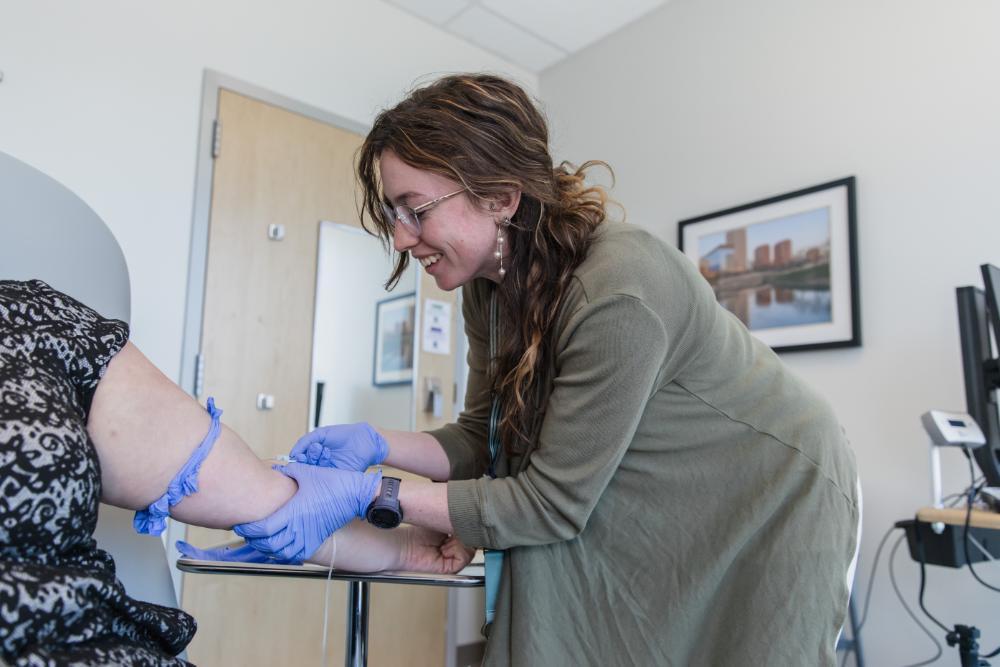
Advancing understanding of movement disorders
A goal of the VCU Parkinson’s and Movement Disorders Center is to advance the understanding of Parkinson’s disease and other movement disorders, in terms of both defining biological causes and developing novel treatments. Ongoing clinical research is necessary to achieve this important goal. A unique feature of our center is the on-site collaboration of clinician specialists representing several disciplines that bring a diverse knowledge and perspective to clinical research investigations.
Clinical Research
PMDC clinical research starts with patients. The Center’s large movement disorders practice and its specialty clinics support enrollment in investigator-initiated studies, industry and federally funded clinical trials, and national natural history, biorepository and genetic registry projects. Foundations have named the PMDC a Center of Excellence for Parkinson’s disease, Lewy body dementia, Huntington’s disease, multiple system atrophy, progressive supranuclear palsy and ataxia. That gives PMDC patients access to research in both common and rare movement disorders. In 2025, core PMDC members held 43 active grants totaling $10.8 million in direct funding, many of them shared across departments.
The PMDC Pilot Grants Program adds to this work by funding new clinical projects across VCU. Neurologists, neurosurgeons and neuropsychologists work alongside biomedical engineers, computer scientists, physical and occupational therapists, nurse scientists, psychologists and public health researchers. The projects aim to measure symptoms more objectively, understand the brain signals behind disabling problems like freezing of gait and falls, improve quality of life beyond motor symptoms, and make sure care reaches everyone in Virginia who needs it.
Clinical Research Themes
- Brain signals and smarter deep brain stimulation (DBS). Dr. Dean Krusienski (Biomedical Engineering), Dr. Kathryn Holloway (Neurosurgery), Dr. Leslie Cloud and Dr. Ingrid Pretzer-Aboff lead a group that records signals directly from DBS electrodes. Using machine learning with collaborators at William & Mary, they are trying to detect and predict freezing of gait, find brain markers of poor balance and fall risk, and improve DBS settings for essential tremor. Several of these projects are led by MD/PhD trainees (Josephine Wallner, Nicholas Druck).
- Objective, at-home and in-clinic measurement. Dr. Eyuphan Bulut and Dr. Brian Berman are building a home Wi-Fi sensing system that monitors Parkinson’s symptoms without wearable devices. Dr. Changqing Luo has conducted research to improve security for these systems. Other teams are building tools to quantify essential tremor with video recorded from several angles, in the clinic and in the operating room (Dr. Joseph Bell, Neurosurgery).
- Movement, exercise and rehabilitation. Dr. Cloud’s study tests blood flow restriction training to build strength in people with Parkinson’s. Dr. Krusienski and Dr. Brooke Dexheimer (Occupational Therapy) are studying how essential tremor affects the brain’s ability to adjust movements based on what a person sees. Dr. Dexheimer’s mentored career award examines early fine-motor deficits in PD.
- Non-motor symptoms and quality of life. SLEEP-PD, led by Dr. Natalie Dautovich and Dr. Sarah Lageman, tests a group-based treatment for insomnia in Parkinson’s. Dr. Japleen Kaur and Dr. Stephanie Bissonnette are measuring swallowing problems across the stages of Huntington’s disease. Other research has focused on how autonomic dysfunction contributes to cognitive decline in PD.
- Access, equity and population health. Dr. Annie Rhodes and colleagues in Gerontology, Public Health, Neurology and Pharmacy are producing Virginia’s first population-based estimates of how common Parkinson’s is. They are also mapping “care deserts” where patients lack access to movement disorders specialists.
Participation in research projects is always voluntary, can be stopped at any time, and will not affect client access to the Parkinson’s and Movement Disorders Center evaluation or treatment process.
Learn about current research projects:
- Early disease motor treatments
- Dyskinesias
- Gait freezing
- Sleep and cognition
- Genetic testing
- Biomarker development
- Imaging studies
- Supportive services and healthcare navigation
Researchers at the PMDC are working hard to find ways to stop the progression of Huntington’s disease, an incurable hereditary disorder that causes progressive difficulty in controlling movements, as well as changes in cognition and personality.
Our center is participating with several other research hospitals in a trial of a gene therapy that seeks to lower the amount of the disease-causing protein that causes brain cells to die in Huntington’s patients. Our researchers are also taking part in a clinical trial of a novel drug that might help improve cognitive symptoms of that disease.
- Natural history
- Gene therapy
We have an active research program and are a site for multiple clinical trials at any given time. We are currently an active site for Enroll-HD. Clinical research visits are conducted at the Short Pump Pavilion or the Clinical Research Services Unit at VCU Medical Center.
We are happy to contact any interested HD families with research opportunity updates. We are developing programs for everyone: those with HD, at risk, and family members!
For more information about our clinical research program, please contact PDCenter@vcuhealth.org.
VCU is hoping to find answers that will help us improve the quality of life for people living with dystonia, as well as insights into what causes it and better ways to diagnosis it. With a half-dozen studies into dystonia underway here, PMDC is among a handful of medical centers nationwide pursuing research into a disorder that’s not well understood and is often misdiagnosed.
- Natural history and biorepository
- Imaging studies
- Patient-centered outcomes
Interested in participating?
Volunteers
The center relies on volunteers to partner with us to achieve these goals and advance the understanding of movement disorders. By participating in clinical research, individuals have the opportunity to contribute to the discovery of new medications and therapies to treat movement disorders.
If you are interested in being a participant in a research study, please contact us at 804-628-2022 or email us at pdcenter@vcuhealth.org.
The VCU Center for Clinical and Translational Research office provides information for potential research volunteers.
Clinical Research outside VCU
You can find additional information on clinical research studies outside of VCU at https://clinicaltrials.gov/.